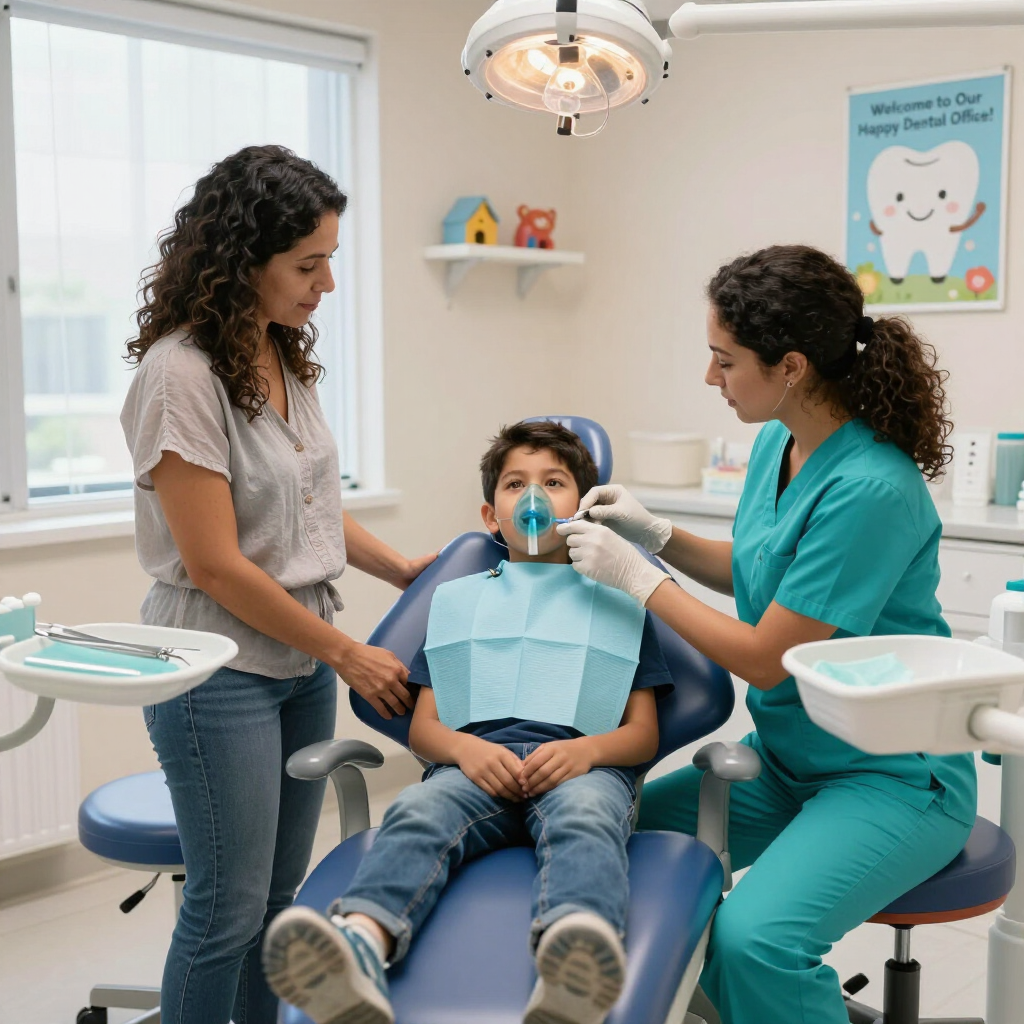
For a nervous but cooperative child with a small amount of treatment. Awake, relaxed, home in minutes, no fasting.
Sedation Dentistry and General Anesthesia for Children in Pomona, CA
Sedation is the part of children's dentistry where the question "who exactly is doing this?" matters most. At Kids Dental Castle & Orthodontics, the answer is four board-certified dental anesthesiologists who are members of our own practice — not a service we rent by the day — working in our Pomona office alongside the dentist treating your child. This page explains who they are, how a sedation visit is run, which children it's for, what it costs, and what Medi-Cal Dental covers.
Who Administers Anesthesia Here
Every IV sedation and general anesthesia case at Kids Dental Castle is administered and monitored by one of these four dental anesthesiologists. Each is board-certified, and each does nothing during the visit except your child's anesthesia — the dentistry is done by a separate dentist.
• Dr. Charles Lee — DDS, Loma Linda University; postdoctoral anesthesia training, New York University; U.S. Army veteran. Member, American Society of Dental Anesthesiologists and American Dental Society of Anesthesiology.
• Dr. Albert Kang — DDS and postdoctoral dental anesthesia training, Loma Linda University; BA, UC Irvine. Member, ASDA and ADSA.
• Dr. Ji Yoon Choi — DDS, New York University (seven-year joint BA–DDS program, biology cum laude); general practice residency and anesthesiology training, Wyckoff Heights Medical Center. Member, ASDA and ADSA.
• Dr. Andrew Elmasri — DDS with honors in anesthesia and implantology, Loma Linda University; postdoctoral dental anesthesia training, Loma Linda; BS in biomedical engineering, UC Irvine; dual board-certified. Member, ASDA, ADSA, and the International Anesthesia Research Society.
Why this is worth a whole section: a dental anesthesiologist completes a two-to-three-year hospital-based anesthesia residency after dental school, and board certification adds an examination on top of that. Having four in-house is what lets us schedule a sedation visit within a couple of weeks, and it's why families are referred here from other dentists for exactly this.
Ask Which Option Fits Your Child
The Anesthesia Conversation, in Your Language
Before any child is sedated, there's a conversation: medical history, what the medication does, what the risks actually are, how long recovery takes, and what to watch for that night. It is the most important conversation in the whole process, and it's the one you least want to have in your second language.
Our dental anesthesiologists speak four languages beyond English and Spanish:
• Mandarin and Cantonese — Dr. Charles Lee
• Korean — Dr. Albert Kang and Dr. Ji Yoon Choi
• Vietnamese — Dr. Vy Le
• Arabic — Dr. Andrew Elmasri
• Spanish — spoken throughout our office, front desk to treatment room
Our anesthesiologists are in the office on sedation days. Tell us which language you speak when you call and we'll tell you what we can arrange. Our front desk works in English and Spanish, and family members or your own interpreter are always welcome in the room.
Three Levels, Decided at a Free Consultation
We don’t pick a sedation level from a menu; we pick it after examining your child and talking with you. Briefly:
Nitrous oxide for a nervous but cooperative child with a small amount of treatment. Awake, relaxed, home in minutes, no fasting. Full detail on our nitrous oxide for children page.
IV sedation for a child who can’t tolerate treatment awake — more work to do, a strong gag reflex, or anxiety that nitrous won’t touch. Asleep and comfortable, continuously monitored, home an hour or so after.
General anesthesia for extensive treatment completed in a single visit: a toddler with early childhood decay across many teeth, a child with special healthcare needs for whom awake treatment would be traumatic, or a teen having four impacted wisdom teeth removed. Full detail on our IV sedation and general anesthesia page.
For most children we see, the honest recommendation is the lowest level that will get the work done well. Sedation is a tool for finishing treatment safely, not a default.
Three Levels, Decided at a Free Consultation
We don’t pick a sedation level from a menu; we pick it after examining your child and talking with you. Briefly:
Nitrous oxide for a nervous but cooperative child with a small amount of treatment. Awake, relaxed, home in minutes, no fasting. Full detail on our nitrous oxide for children page.
IV sedation for a child who can’t tolerate treatment awake — more work to do, a strong gag reflex, or anxiety that nitrous won’t touch. Asleep and comfortable, continuously monitored, home an hour or so after.
General anesthesia for extensive treatment completed in a single visit: a toddler with early childhood decay across many teeth, a child with special healthcare needs for whom awake treatment would be traumatic, or a teen having four impacted wisdom teeth removed. Full detail on our IV sedation and general anesthesia page.
For most children we see, the honest recommendation is the lowest level that will get the work done well. Sedation is a tool for finishing treatment safely, not a default.
IV Sedation & General Anesthesia
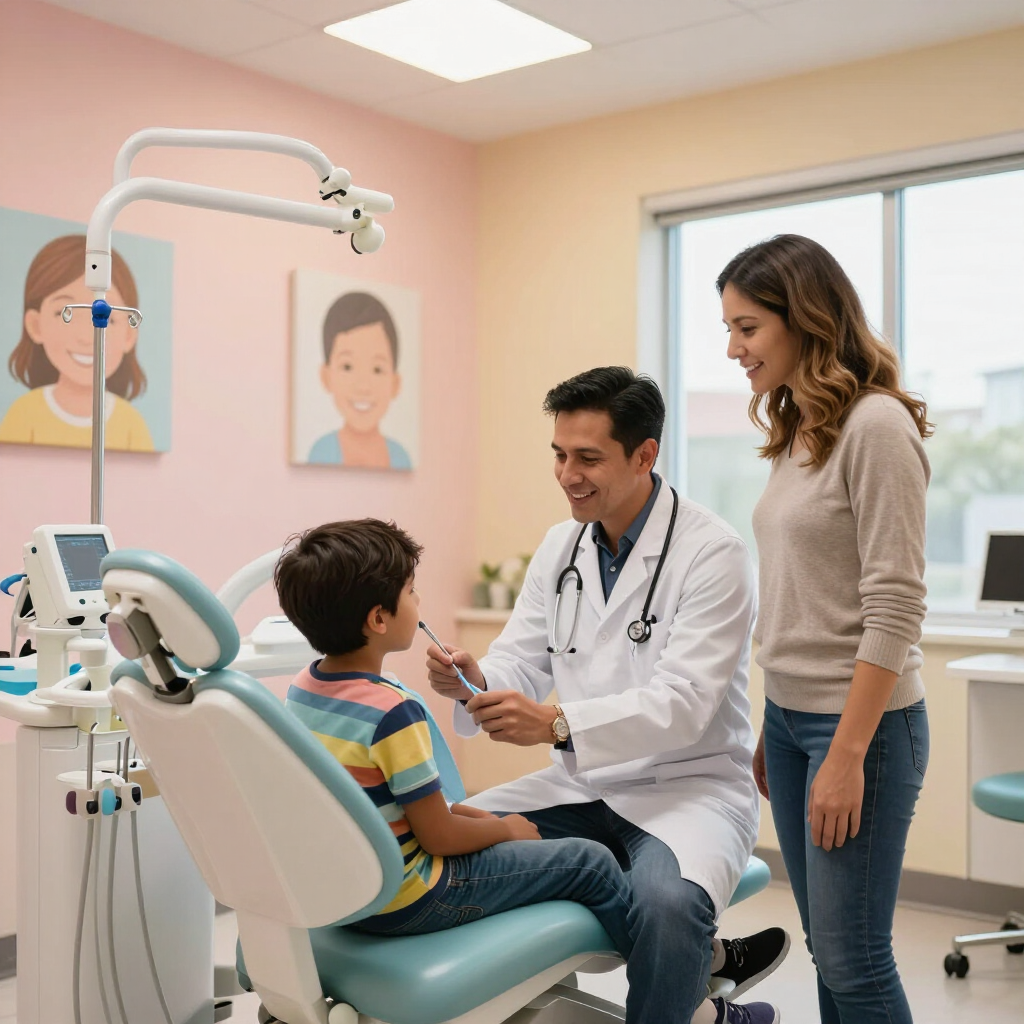
For a child who can't tolerate treatment awake, has extensive work to do, or needs it completed in a single visit. Asleep and comfortable, continuously monitored throughout.
Special Needs Dentistry
Patients with special healthcare needs are a routine part of this practice, and our in-house anesthesia team makes it possible: a desensitization visit with no treatment, a parent in the room, consistent staff, and a sedation plan when cooperation isn't realistic. Our special needs dentistry page covers the approach.
Frequently Asked Questions
Is general anesthesia safe for a child?
When administered by a board-certified dental anesthesiologist with continuous monitoring and a reviewed medical history, it's very safe, and it's the standard of care for young children with extensive treatment needs. The anesthesiologist will discuss risks specific to your child.
Is the anesthesia done in your office or at a hospital?
In our Pomona office, by our own anesthesiologists, with hospital-style monitoring.
Who is watching my child during the procedure?
The anesthesiologist — continuously, and only that. The dentist does the dental work.
What if my child has a cold on the day?
Call us. A congested airway is a reason to reschedule, and we would rather move the date than proceed.
Does my child need to see the pediatrician first?
Sometimes. The anesthesiologist decides based on the medical history and may request a clearance note.
How long will my child be asleep?
It depends on the amount of treatment — often one to two hours for general anesthesia. Recovery adds roughly another hour before you go home.
Can I be there when my child wakes up?
Yes. Parents are in the recovery area as the child wakes.
What can my child eat afterward?
Soft foods and liquids for the rest of the day. You'll get written instructions.
Can you sedate a child with autism or another special need?
Yes. This is a large part of what our anesthesia team does.
How much does sedation cost?
Quoted in writing at the free consultation. For wisdom-teeth surgery it's a flat $1,200.
Does Medi-Cal pay for sedation?
Yes, when medical-necessity criteria are met. We submit the authorization and confirm coverage before scheduling.
Can a general dentist provide this kind of sedation?
Nitrous oxide, yes. IV sedation and general anesthesia for children require an anesthesia provider with the specific training and permit; here that provider is a board-certified dental anesthesiologist.
How a Sedation Visit Is Run
Parents want to know the process, so here it is, start to finish.
Before the day. You'll have a written treatment plan and a written anesthesia plan. The anesthesiologist reviews your child's medical history — asthma, heart conditions, prior anesthesia, medications, recent illness — and may ask for a note from your pediatrician. You'll get fasting instructions with exact times for solids, milk, and clear liquids. If your child has a cold, cough, or fever in the days before, call us; we reschedule rather than proceed with a congested airway.
Arrival. You check in, the anesthesiologist meets your child and you, and answers questions. For IV sedation and general anesthesia, medication is usually started while your child is still with you.
During treatment. Your child is monitored continuously — heart rate and rhythm, oxygen level, blood pressure, breathing, and temperature — by the anesthesiologist, whose only job is that monitoring. The dentist works. Our operatories are equipped for airway management and emergencies in the same way an outpatient surgery center is, and the team runs emergency drills.
Recovery. Your child wakes in a recovery area with you present. Most children are groggy and a little weepy for a while, then normal within a few hours. You'll go home with written instructions on eating, activity, and what's normal for the rest of the day, and a phone number that reaches us that evening.
Who Sedation Is For — and Who It Isn't
Good candidates: children under about five with multiple cavities; children with significant dental anxiety after a bad experience elsewhere; children with a strong gag reflex; patients with special healthcare needs — autism, sensory processing differences, Down syndrome, cerebral palsy — who cannot cooperate with awake care; teens facing wisdom-teeth surgery.
Not the first choice: a child with one small cavity who is simply nervous. That's a nitrous visit, or sometimes a tell-show-do visit with no medication at all. If another office has recommended general anesthesia for a small amount of treatment, a second opinion here is free.
What It Costs, and What Medi-Cal Covers
Fees. The anesthesia fee is separate from the dental work and depends on the level and the length of the case; you'll have it in writing at the consultation, before anything is scheduled. For wisdom-teeth surgery, IV sedation or general anesthesia is a flat $1,200.
Medi-Cal Dental. Sedation and general anesthesia for children are covered when Medi-Cal's medical-necessity criteria are met — typically age, the extent of treatment, or a special healthcare need. Pomona is in Los Angeles County, so children's dental benefits run through Medi-Cal Dental directly. We submit the authorization and confirm coverage before the visit, not after.
PPO. Most PPO plans cover part of the anesthesia fee for children under a certain age or with documented need; we verify before scheduling.
No insurance. The initial exam and X-rays are free for uninsured children, CareCredit is accepted, and paying in full in cash earns 5% off.
Para Familias que Hablan Español
Se habla español. Podemos explicar en español cada opción de sedación, las instrucciones de ayuno, y lo que cubre Medi-Cal Dental. Los anestesiólogos revisan el historial médico de su hijo antes de la cita y usted está presente cuando se despierta.
Where We Are
Kids Dental Castle & Orthodontics
1532 San Bernardino Ave #A1, Pomona, CA 91767
909-741-7052 · Monday–Friday 9–6 · Saturday 8–2
Just north of the 10 in Pomona, near the Kellogg interchange with the 57 and 71. Families come for sedation dentistry from across the Pomona Valley and the western Inland Empire — Claremont, La Verne, San Dimas, Diamond Bar, Walnut, Montclair, Upland, Ontario, Chino, and Chino Hills.