Wisdom Teeth Removal for Rancho Cucamonga, CA — Teens and Adults, With the Prices Published
Rancho Cucamonga sends us two very different patients. The first is a 15-year-old from Alta Loma or Etiwanda whose orthodontist spotted third molars forming on a panoramic X-ray. The second is a 27-year-old who never had them out, gets a dull ache behind the back molars a few times a year, and wants to know whether it's finally time.
Both are handled by the same surgeon, at the same price, in the same Pomona office: Dr. Sean Moghadam, board-certified in oral and maxillofacial surgery. The questions are different, so this page answers them separately. The consultation, exam and panoramic X-ray are free. Se habla español.
First, the Numbers
No oral surgery office in Rancho Cucamonga publishes a price on its wisdom teeth page. Ours:
• $300 per wisdom tooth
• $1,200 flat for IV sedation or general anesthesia — the same fee whether one tooth comes out or four
Four teeth under IV sedation is $2,400. A single erupted tooth under local anesthetic is $300. You know the number before you call, and you get it in writing for your specific case at the consultation.
Insurance: we accept IEHP, Medi-Cal Dental, and PPO plans. Rancho Cucamonga is in San Bernardino County, so IEHP applies here — unlike our LA County patients. Our front office verifies coverage for both the extraction and the sedation before the appointment, not after.
Paying yourself: zero-interest in-house financing, CareCredit, and 5% off for paying in full in cash, which stacks with CareCredit.
For Teens: Catching It Early Is the Point
Wisdom teeth are easier to remove before the roots finish forming. A tooth caught in the mid-teens, sitting at an angle with roots still developing, is a routine procedure with a faster recovery than the same tooth at 30, fully rooted and pressed into the second molar.
That’s why we recommend a first evaluation at 13 or 14. It doesn’t mean surgery then. It means Dr. Moghadam can see where each tooth is headed and tell you whether the plan is “remove now,” “remove the summer before senior year,” or “these have room, leave them.”
Los Osos, Etiwanda, Rancho Cucamonga High and Alta Loma High students usually land in the middle bucket — the surgery gets scheduled for winter or spring break so recovery doesn’t cost school days. If your teen is in braces with us or with another orthodontist, we coordinate directly; sometimes an extraction is part of making the orthodontic plan work.
For Adults: Is It Too Late? No.
There’s no age cutoff. Plenty of Rancho Cucamonga adults come in because the watching finally turned into something — recurring soreness, food trapping behind the last molar, or a partially erupted tooth that keeps getting inflamed. Chaffey College students, parents in their thirties and forties, people who were told years ago “we’ll keep an eye on them.”
Adult extractions can be more involved, because the roots are complete and the bone is denser, so surgical time may be longer and the swelling takes a little more time to settle. They’re still done routinely in our office under IV sedation or general anesthesia. Dr. Moghadam will tell you plainly what your case looks like: an erupted tooth with straight roots is a simple extraction at any age; a deeply impacted one takes more surgical time. The pricing is the same either way.
One practical difference for adults — plan for two or three days where you’re not at your best. Most people take the surgery day and the next day off work, and a desk job is manageable by day three.
Who Performs the Surgery, and Who Gives the Anesthesia
Dr. Moghadam, on both counts. He graduated with honors from UCLA, completed a General Practice Residency at Rancho Los Amigos National Rehabilitation Center, a surgical internship and clinical instructor role at The Ohio State University, and his Oral & Maxillofacial Surgery residency at Cook County Hospital in Chicago. He is board-certified in oral and maxillofacial surgery.
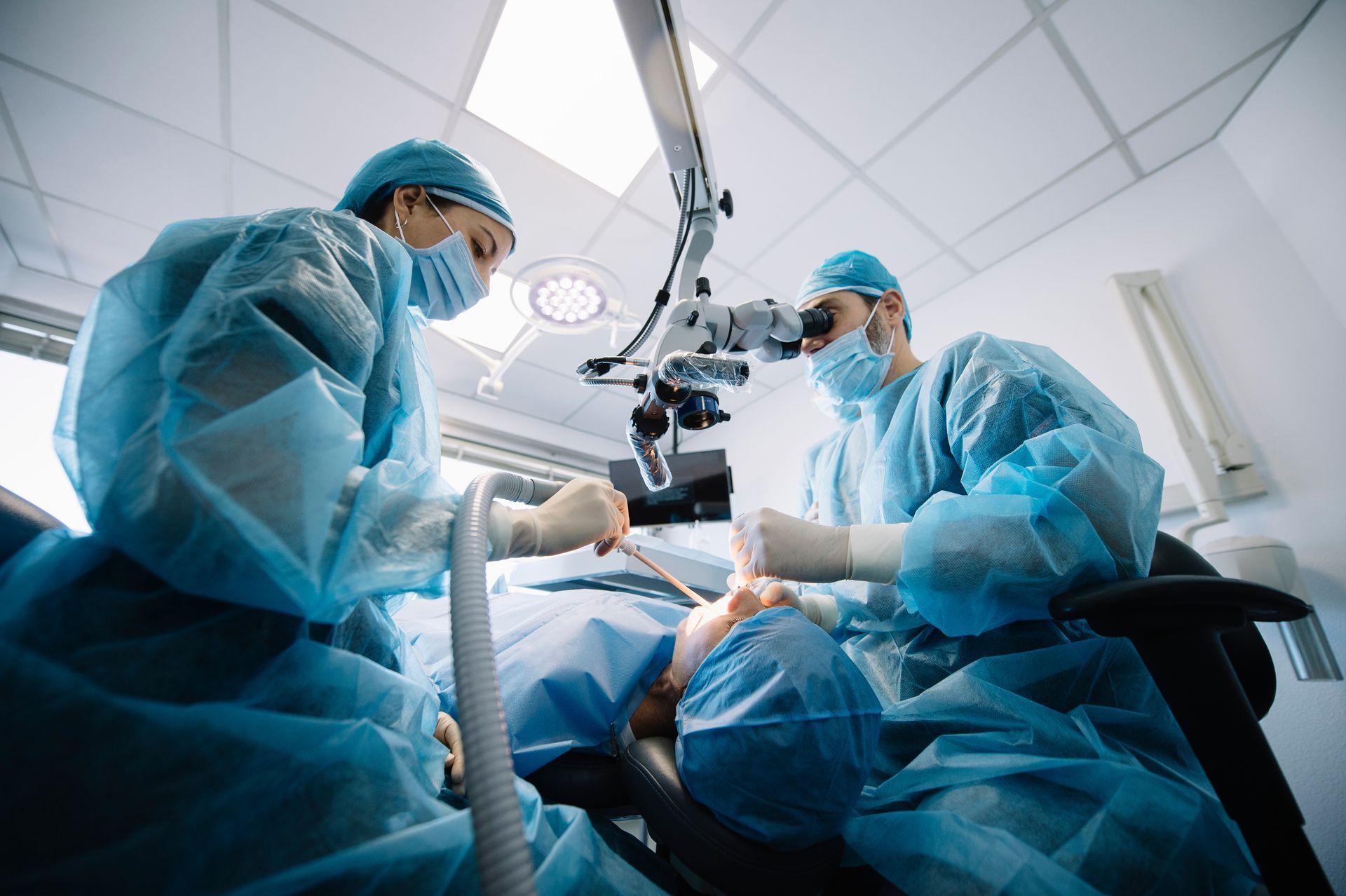
He performs every surgical case in this office personally — there is no associate surgeon and no rotating provider — and he administers the IV sedation himself, as part of the anesthesia training that comes with an oral surgery residency. There’s no outside anesthesiologist to schedule around and no hospital trip.
If Your Regular Dentist Offered to Do It
That happens often, and it isn’t wrong. A family dentist who has taken out hundreds of erupted third molars can handle a straightforward one, and if yours is comfortable with your particular case, staying put is a fine choice.
Where it’s worth a second opinion: a tooth that’s buried in bone, a lower tooth whose roots overlap the nerve canal on the X-ray, an upper tooth sitting up against the sinus, a history of a difficult extraction, or any case where you’d want to be asleep. Those are the referrals general dentists make, and they’re routine here rather than unusual. If you’ve been quoted by another office and want a read on the X-ray, bring it — the second opinion costs nothing.
Sedation, Matched to the Case
Nitrous oxide, IV sedation and general anesthesia are all available in our Pomona office. A single erupted tooth may need only local anesthetic. Four impacted teeth almost always means IV sedation — the patient is asleep and remembers none of it. An anxious patient of any age can have sedation for a procedure that technically wouldn’t require it. Dr. Moghadam recommends the level that fits and doesn’t default to the heaviest option.
“Do I Really Need All Four Out?”
The most common question in the consult room, and the answer is often no. Each third molar gets judged on its own: can it be cleaned, is it doing damage, is it likely to cause trouble in the next few years. A tooth that’s fully up, straight, and reachable with a toothbrush can stay and get re-checked. A tooth that’s decayed, infected, tipped into its neighbor, or trapped under gum tissue comes out.
People leave here with all sorts of plans — take two now and leave two, take one and watch the rest, or do nothing this year. The number is whatever the X-ray supports.
Other Extractions
We also remove teeth that can't be predictably restored, teeth that have failed a root canal, and teeth that need to come out to make room for orthodontic treatment. Same surgeon, same firm quote at the consultation.
Getting Here From Rancho Cucamonga — Including the Drive Home
The office is at 1532 San Bernardino Ave, Suite A1 in Pomona, about 20 to 25 minutes away. Three real routes:
• The 210 west, exiting at Towne or Garey — usually the fastest from Alta Loma and the north side.
• The 15 south to the 10 west through Ontario, Montclair and Claremont — the common route from Etiwanda and Victoria Gardens.
• Foothill Boulevard straight west through Upland, Claremont and La Verne. No freeway at all. Worth knowing for the ride home after IV sedation, when a smoother, slower drive is easier on a groggy passenger.
Whoever drives you home should plan on the same route back. We also see oral surgery patients from Fontana, Upland, and Ontario. If you have younger children, our pediatric dentistry and orthodontic teams are in the same building.
Kids Dental Castle & Orthodontics
1532 San Bernardino Ave #A1
Pomona, CA 91767
909-741-7052 · Monday–Friday 9–6 · Saturday 8–2
Frequently Asked Questions
I'm an adult. Is wisdom teeth removal harder or riskier at my age?
It can be more involved because the roots are fully formed and the bone is denser, so surgical time may be longer. It's still done routinely in our office under sedation. Dr. Moghadam will tell you specifically what your case involves after looking at the X-ray.
At what age should my teen be evaluated?
Thirteen or fourteen is the right window for a first panoramic X-ray. Almost nobody has surgery at that age; the point is to see the direction the roots are taking while there's still time to pick a convenient date.
How long does swelling last after wisdom teeth removal?
Swelling usually peaks on day two or three, then fades over the rest of the week. Ice on and off for the first 24 hours keeps it down; warm compresses after that help it resolve. Swelling that is getting worse after day three is a reason to call us.
I only have one wisdom tooth bothering me. Do all four have to come out?
Not necessarily. If the other three have room and aren't causing problems, Dr. Moghadam may recommend removing just the one. Some patients choose to do all four at once to avoid a second recovery — that's a conversation, not a rule.
Do you take IEHP or Medi-Cal for adults?
Yes — Medi-Cal Dental, IEHP, and PPO plans, for patients of any age. Adult Medi-Cal dental benefits vary by procedure, so we verify coverage before your visit.
How many days off work or school do I need after wisdom teeth removal?
Most people take two to three days. Desk work and classes are usually manageable by day three or four; physical jobs and exercise wait closer to a week. Don't drive while taking prescription pain medication.
Why is the gum around my wisdom tooth swollen?
Usually pericoronitis: an infection of the gum flap over a partly erupted wisdom tooth, where food and bacteria get trapped. Warm salt-water rinses help short term, but it tends to return. If it has happened more than once, that tooth is a strong candidate for removal. Jaw swelling, fever or trouble swallowing should be seen the same day.
Is IV sedation safe for wisdom teeth removal?
For healthy teens and adults, yes; it's routine. Dr. Moghadam is a board-certified oral and maxillofacial surgeon whose hospital residency included anesthesia training. He reviews your medical history beforehand and monitors breathing, heart rate and oxygen throughout. You'll need an adult to drive you home.
What does wisdom teeth removal cost here?
$300 per wisdom tooth, plus a flat $1,200 if IV sedation or general anesthesia is used — $2,400 for four teeth under sedation. The consultation and X-rays are free.
Is the consultation really free?
Yes. The exam and panoramic X-ray cost nothing, and you leave with a written price for whatever is recommended, whether or not you schedule surgery.
How long is recovery?
Expect to be off your feet the day of surgery and the day after, noticeably better by the third or fourth day, and back to normal meals inside a week. Teeth that were buried in bone add a few days to that.
¿Hablan español?
Sí. Se habla español en nuestra oficina, y la consulta es gratis.