Kids Dentist Near Upland, CA: What Happens When the Checkup Finds a Cavity
Most of what a children's dentist does is checkups that end with "everything looks fine." This page is about the other visit, the one where the dentist turns the screen toward you and points at a dark spot on a baby molar. Upland parents call us after that visit more than any other, usually with the same three questions: does a tooth that is going to fall out anyway really need fixing, what exactly is going to be done to my child, and what will it cost with the insurance we have. The answers depend on which tooth it is, how deep the decay has gone and how old your child is, and this page walks through each of those so the plan you are handed makes sense before you agree to it.
Treatment is done at our Pomona office by Dr. Nima Javan, a general and children's dentist who has focused his practice entirely on children, teens and patients with special healthcare needs, about fifteen minutes down Euclid Avenue and the 10 from central Upland. A first visit for a child without dental insurance is free, exam and X-rays included, and the $100 new-patient visit adds the cleaning and fluoride. If a cavity is found, you leave with a written plan and a price for each tooth, not an estimate to be confirmed later.
Which Baby Teeth Fall Out When, and Why It Changes the Plan
The first thing that decides what happens to a cavity is how long the tooth has left. Baby front teeth loosen around 6 or 7. Baby molars, the teeth in the back where most children's cavities are, stay until 10, 11 or 12. So a small cavity in a front tooth of a 6-year-old may need nothing more than watching, while the same-sized cavity in a back molar of a 6-year-old has five or six years to grow, and it will.
Decay in a baby tooth moves faster than in an adult tooth because the enamel is thinner and the nerve sits closer to the surface. A spot that is only in the enamel today can reach the nerve within a year or two, and by then the choices are narrower and the appointment is longer. That is the reason the recommendation is usually to treat a back-tooth cavity early, when it is a small filling, rather than wait and see.
The second thing is what happens to the space. A baby molar that is pulled at 7 because it was left too long leaves a gap that the neighboring teeth drift into, and the permanent tooth due at 11 arrives with no room. Holding that space takes a small appliance called a space maintainer and another set of visits. Treating the cavity in the first place avoids all of it.
Filling, Crown, or Something Else: How the Choice Gets Made
For a cavity that is small and has not reached the nerve, the treatment is a filling, tooth-colored, in one visit. The decay is cleaned out and the tooth is rebuilt in the same appointment.
For a larger cavity on a baby molar, especially one that wraps around more than one side of the tooth, the usual recommendation is a stainless steel crown rather than a big filling. Large fillings on baby molars fail at a high rate because the tooth is small and takes the full force of chewing; the crown covers the whole tooth and lasts until it falls out on its own. It is placed in one visit, with no impressions and no lab wait, and it is the standard of care for this situation, not a shortcut.
When the decay has reached the nerve, the options are a pulpotomy, which removes the infected part of the nerve so the tooth can be kept under a crown until it is due to fall out, or removing the tooth and holding the space. Which one makes sense depends on how much of the root is left and how close the permanent tooth is to coming in, and Dr. Javan shows you the X-ray and explains which he recommends and why.
For very small early cavities, and for toddlers who are not ready to sit for a filling, there is a fourth option that most parents have not heard of, covered next.
Silver Diamine Fluoride: Stopping a Cavity Without a Drill
Silver diamine fluoride is a liquid painted onto a cavity that stops the decay from advancing. It takes about a minute, there is no drilling and no numbing, and it works well on small cavities in baby teeth and on children who are too young to tolerate anything more. The trade-off is cosmetic: the treated spot turns dark, permanently, which is why it is used on back teeth far more often than on front ones, and why we explain that clearly before using it.
For a 2- or 3-year-old with early decay on several molars, it can be the difference between a quick visit now and a treatment under sedation later. The spots are rechecked at each visit and, when the child is older and the tooth is still in place, a filling or crown can be placed over the arrested decay if needed. Our pediatric dentistry page covers the full range of what is done at a routine visit.
How a Five-Year-Old Gets a Filling Here
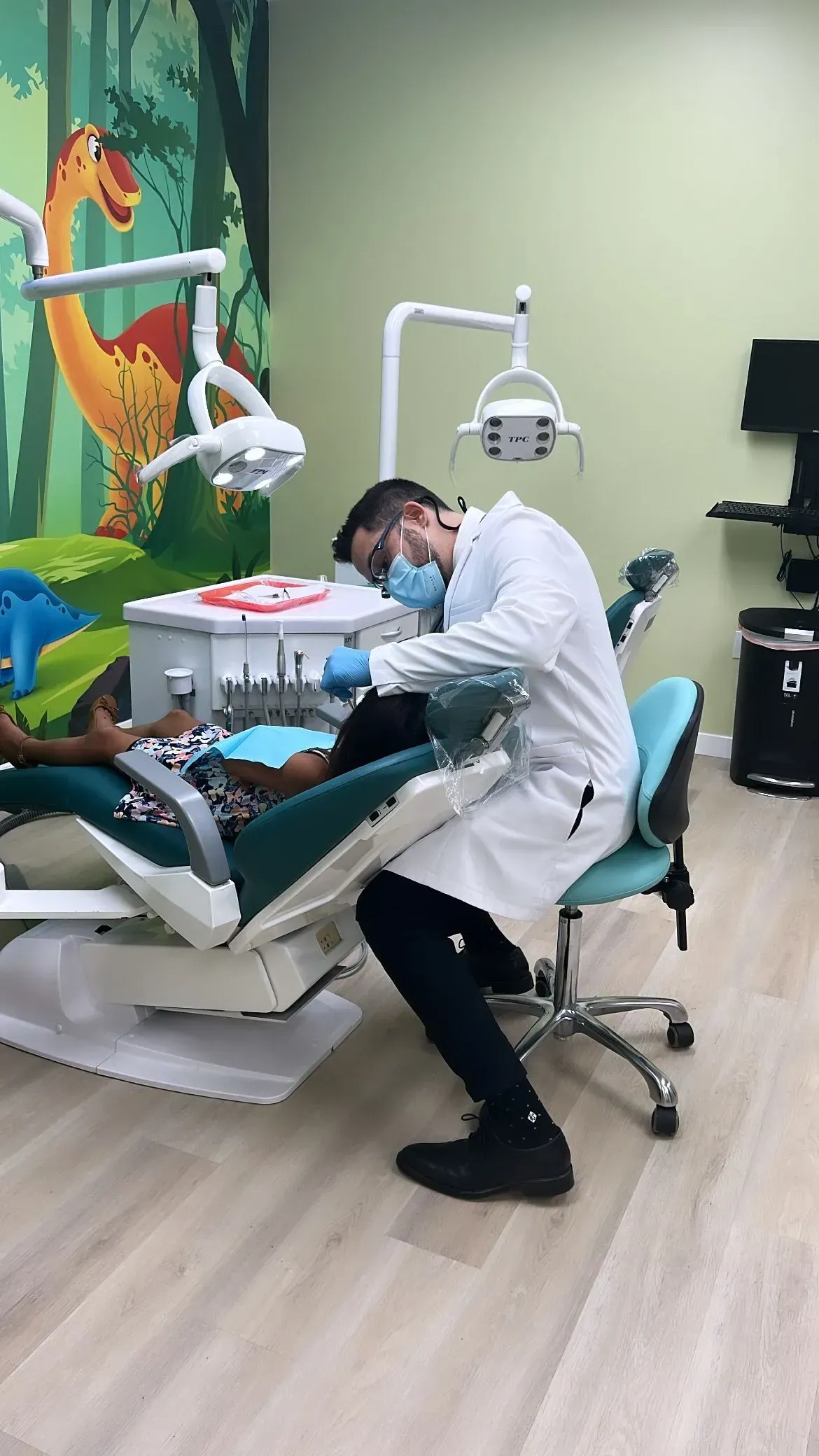
Most children between 4 and 8 can have a filling or crown done awake, and the way it is done matters more than the procedure itself. The child sees and touches the instruments before anything starts. A numbing gel goes on the gum first, so the injection that follows is not felt as a sharp pain; children are told the tooth is going to "fall asleep" and nothing more. One side of the mouth is treated per visit, so the appointment stays around half an hour and the child goes home numb on one side only. For a child who is wiggly or worried, nitrous oxide through a small nose mask takes the edge off and wears off before you reach the parking lot.
Some children need more than that: a 3-year-old with eight cavities, a child who could not get through a cleaning, or a child with a developmental or medical condition that makes a long awake appointment unrealistic. For them, the treatment is done in one visit under IV sedation or general anesthesia, in our office, given by one of the four board-certified dental anesthesiologists on staff: Dr. Charles Lee, Dr. Albert Kang, Dr. Ji Yoon Choi and Dr. Andrew Elmasri. Upland families often expect this to mean a hospital day, since the hospital is the city's biggest employer and the usual answer for anything involving anesthesia. It does not. The anesthesiologist, the monitoring and the dentist are all in the same treatment room in Pomona, and the child goes home the same morning. The sedation page explains how each option is chosen.
What IEHP and Medi-Cal Dental Cover for Upland Children
Upland is in San Bernardino County, so most families on Medi-Cal here carry an IEHP card. IEHP is the medical plan. Your child's dental benefit does not run through IEHP; it is administered by Medi-Cal Dental, and we bill Medi-Cal Dental directly, so bring both cards and the front desk sorts out the rest. Until age 21 the program pays for a checkup and cleaning twice a year, the X-rays that find cavities between the teeth, fluoride, sealants on the permanent molars, fillings, stainless steel crowns, the pulpotomy described above, and an emergency visit when a tooth hurts. In practice, that means the cavity plan on this page costs a Medi-Cal family nothing out of pocket.
PPO plans are accepted and benefits are verified before the visit, so you know the plan's share before the child is in the chair. HMO dental plans are not accepted. If your child has no coverage, the exam and X-rays are free, the new-patient visit with cleaning and fluoride is $100, and every filling or crown is priced in writing per tooth before it is scheduled. We do not publish a single filling price here because the fee depends on the tooth and the size of the cavity, but you will have the number before you decide, and it will not change at checkout.
Keeping the Next Checkup Clean
Once a cavity has been treated, the question is why it was there. In young children the cause is usually one of three things: a bottle or sippy cup of anything other than water at bedtime, juice or sports drinks sipped through the day, or sticky snacks that sit in the grooves of the back molars. The dentist will tell you which one applies, because the pattern of decay in the mouth usually shows it.
Two things prevent most back-tooth cavities from here on. Sealants, a thin coating painted into the grooves of the permanent molars when they come in around age 6 and again around 12, keep food out of the one place a toothbrush cannot reach; Medi-Cal Dental covers them. Fluoride varnish at each six-month visit hardens the enamel of the teeth that are still in. And until about age 8, a parent does the night brushing, because a child's hands are not yet steady enough to clean the back teeth alone.
Para Familias de Upland
Hablamos español en toda la oficina, desde la recepción hasta la sala de tratamiento, y la explicación del plan de tratamiento se hace en su idioma, con la radiografía en la pantalla. Si su hijo tiene la tarjeta de IEHP, la parte dental se cobra a Medi-Cal Dental; nosotros nos encargamos de la facturación y las empastaduras, las coronas y las visitas de emergencia no tienen costo para la familia. Sin seguro, la primera revisión con radiografías no cuesta nada, y por $100 se agrega la limpieza y el flúor en la misma cita. Antes de cualquier tratamiento le entregamos el precio por escrito, diente por diente. Para niños muy pequeños o con muchas caries, la sedación se hace en nuestra oficina en Pomona con anestesiólogos dentales certificados, sin ir al hospital. Llame al 909-741-7052; estamos a unos quince minutos de Upland.
Getting Here From Upland
Kids Dental Castle & Orthodontics
1532 San Bernardino Ave #A1
Pomona, CA 91767
Monday–Friday 9–6 · Saturday 8–2
From Euclid Avenue, drive south to the 10, take it west and leave at Towne Avenue or Garey Avenue; the office is at 1532 San Bernardino Avenue, Suite A1, just north of the freeway. From North Upland or San Antonio Heights, Foothill Boulevard west through Claremont is the alternative when the 10 is slow. Either way it is about fifteen minutes from the center of town.
We see children from every Upland Unified school, and families drive in from Rancho Cucamonga, Claremont and Montclair for the same reasons: the orthodontist, the oral surgeon and the anesthesiologists are in the same building as the children's dentist, so a cavity, a loose baby tooth that will not come out and a first orthodontic look can all happen on one visit. The office is open Monday through Friday 9 to 6 and Saturday 8 to 2, and the phone is answered from 6 in the morning to 9 at night, seven days a week, for same-day emergency slots. Directions and the contact form are here.
Related pages: oral surgery in Upland and Invisalign in Upland.
Frequently Asked Questions
Does a cavity in a baby tooth need treatment if the tooth is going to fall out anyway?
It depends on how long the tooth has left. A baby molar stays until age 10 to 12, so a cavity in a 6-year-old's molar has years to reach the nerve and cause pain or an abscess. A front tooth that is already loose may only need watching. The dentist tells you which case yours is.
Why are children's crowns silver, and will it show when my child smiles?
Stainless steel crowns are used on baby molars because they are placed in one visit, cost less than a lab-made crown and last until the tooth falls out. They sit in the back of the mouth and rarely show in a normal smile. For front baby teeth that need a crown, a tooth-colored option is used instead.
What is silver diamine fluoride, and does it really turn the spot black?
It is a liquid brushed onto a cavity to stop it from growing, with no drilling or numbing. Yes, the decayed spot turns dark permanently, which is why it is mostly used on back teeth and on young children who cannot yet sit for a filling. Healthy enamel does not stain.
My three-year-old has several cavities. How is that treated at that age?
Usually in one visit under IV sedation or general anesthesia in our office, given by a board-certified dental anesthesiologist on staff, so the child is not asked to sit through several long awake appointments. For early, small cavities, silver diamine fluoride at a regular visit can be enough to hold things until the child is older.
Will the cavity be fixed at the same visit as the checkup?
Usually not. The checkup visit is for the exam, X-rays, cleaning and the conversation about the plan and the price. Treatment is scheduled for a separate visit so your child comes in knowing what to expect, and so you have agreed to the cost first. Emergencies are the exception.
How long does a filling appointment take for a child?
Plan on about thirty minutes for one or two fillings on the same side of the mouth, including the time for the numbing to take effect. A crown takes a little longer. The numb feeling lasts an hour or two afterward, so lunch waits until it wears off.
Can the dentist see a cavity without X-rays?
Sometimes, when it is on a surface that is visible. The most common cavities in children are between the back teeth, where they cannot be seen at all until they are large. Two small X-rays of the back teeth, taken once a year or so, find them while they are still a small filling.
What happens if a baby tooth gets an abscess?
A swelling on the gum above a baby tooth means the infection has reached the nerve and passed into the bone. It needs to be seen within a day or two, not at the next checkup, because it can spread and can damage the permanent tooth forming underneath. Treatment is a pulpotomy with a crown if the tooth can be saved, or removal with a space maintainer if it cannot. Call us the day you notice it.
Is a pulpotomy the same as a root canal?
Not quite. A root canal on an adult tooth removes the whole nerve down to the root tips. A pulpotomy on a baby tooth removes only the infected part in the crown of the tooth and leaves the healthy root portion, which is why it is faster, done in one visit and then covered with a crown.
Can all of my child's cavities be done in one visit?
Awake, usually one side of the mouth per visit, so two or three visits for cavities on both sides. Under sedation or general anesthesia, everything is done in a single visit. Which is better depends on your child's age, how many teeth are involved and how they handle the chair, and it is decided with you at the checkup.
Do we need a referral from our Upland dentist for a crown or sedation here?
No. Families come to us directly, often after being told by another office that the work would need to be done at a hospital or that the child should wait until they are older. Bring any X-rays you already have, or we take new ones at the free exam, and you get a second opinion and a written price the same day.
¿Hablan español?
Sí. Todo el equipo habla español, y el plan de tratamiento y los precios se explican en español antes de cualquier cita. Llame al 909-741-7052.