Children’s Dentist Near Diamond Bar, CA — The First Visit Explained Before You Get There
Most of what goes wrong in a small child’s mouth was preventable, and the advice that would have prevented it usually arrives as ninety seconds of fast English while the parent is holding a squirming three-year-old and working out whether "occlusal" is a word they should know. Then everyone goes home and nothing changes. That is the real failure. Not the cavity — the conversation.
So this page slows it down: what a first visit looks like start to finish, what you will be asked, and the prevention decisions that genuinely change whether your child needs fillings. Kids Dental Castle & Orthodontics is in Pomona, roughly fifteen minutes north of Diamond Bar on the 57. Dr. Nima Javan is a general and children’s dentist who has focused his practice entirely on children, teens and patients with special healthcare needs. Uninsured children get a free exam and X-rays; Medi-Cal Dental and PPO plans are accepted. Se habla español.
The First Visit, Minute by Minute
Nothing here should be a surprise. Plan on about forty-five minutes total.
Minutes 0–10 — paperwork and questions. Medical history, medications, allergies, birth history if your child is under three, and whether anyone has had trouble getting your child to open their mouth. If there is an IEP or 504 plan with anything dental in it, bring a copy.
Minutes 10–15 — the conversation, before anyone touches anything. Dr. Javan asks what you have noticed: a dark spot, a chip, breath that will not clear, grinding at night, a child who chews on one side only. You have watched your child eat for three years and we have not.
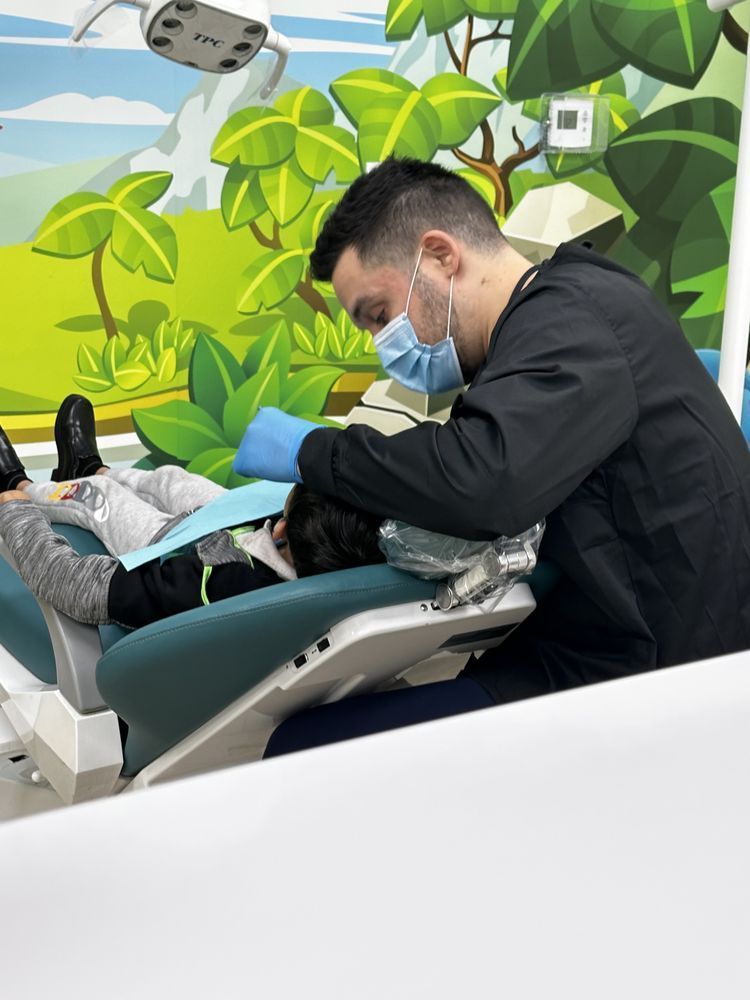
Minutes 15–25 — the exam. An older child sits in the chair alone. A baby or very young toddler stays in your arms, tipped back so there is light in the mouth; about two minutes, and nobody is restrained. We count teeth out loud and check every surface, the gums, the bite and the way the jaw moves.
Minutes 25–35 — cleaning and fluoride varnish. A soft polishing cup, flossing between any teeth that touch, then varnish painted on with a small brush. Twenty seconds, tastes sweet, not rinsed off — soft food for a couple of hours, brushed away that night.
Minutes 35–45 — the plan, in writing. What we found, what needs doing, what it costs, what can wait.
X-rays are not automatic. A toddler with visible gaps between the teeth usually needs none. The first films come when the back teeth touch tightly enough that a mirror cannot see between them — commonly between four and six.
Ask a Question Before You Book
The Prevention Decisions That Actually Matter
Six things account for most of what we end up drilling. None are complicated. All get explained too quickly somewhere else.
Bedtime bottles and sippy cups. A child who falls asleep with milk, formula, juice or sweetened tea in their mouth has that liquid sitting against the upper front teeth for hours with almost no saliva to clear it. It is the most common cause of decay on the four upper front teeth in two- and three-year-olds. Water at bedtime is fine forever, and weaning off the bottle goes better diluted a little more each night over a week or two than stopped cold.
What counts as a sugary drink. More than parents think. Juice counts even when the label says 100% juice and no added sugar — the sugar is already in it, and the acid softens enamel regardless. Sports drinks, sweetened yogurt drinks, boba and milk tea, horchata, flavored milk, soda and most “vitamin” waters all count. Plain milk and plain water do not. Frequency matters more than volume: a cup of juice finished in ten minutes at breakfast does far less harm than the same cup sipped across three hours in the car.
Brushing a toddler who fights it. Assume you are brushing your child’s teeth for them until roughly seven or eight, when most children finally have the hand control to do it properly. Twice a day, two minutes, a rice-grain smear of fluoride toothpaste under three and a pea-sized amount after. If your child clamps down, lay them across your lap with their head toward you and brush from above rather than face to face. Two effective minutes beats six of negotiation.
Fluoride varnish. At every checkup from the first tooth on. It does not treat a cavity; it hardens enamel that has begun to soften so the cavity never forms. Covered by Medi-Cal Dental and effectively every PPO.
Sealants. Thin resin painted into the deep grooves on the chewing surfaces of permanent molars, where a bristle physically cannot reach. The first permanent molars arrive around six, behind the last baby tooth, with nothing falling out first — which is why most parents never notice them. They are sealed as soon as they fully erupt, the second molars around twelve. Covered by Medi-Cal Dental and almost all PPOs.
Thumbs and pacifiers. Most children stop on their own between two and four, and until then it is not worth a fight. It starts to matter past roughly four, and seriously once the permanent front teeth erupt around six, because that is when the pressure pushes them forward. If your four-year-old still sucks a thumb at night, tell us and we will give you a plan that does not involve shaming a preschooler.
What We Check at Each Age, Toddler to Teen
The exam is not the same one repeated.
• 1 to 3 — decay on the upper front teeth, how you are brushing, bottle and cup habits, and whether tongue or lip tissue is restricting movement.
• 3 to 6 — spacing (gaps between baby teeth are a good sign, not a bad one), the first permanent molars, sealants, thumb and pacifier habits, and whether your child tolerates a full cleaning yet.
• 6 to 12 — the mixed years, baby and permanent teeth both present: loose teeth that are not loosening, permanent teeth erupting behind baby teeth, crowding, crossbite, and the first orthodontic screening around seven.
• 12 to 18 — second molars and sealants, wisdom teeth, decay between the teeth of a teenager who has stopped flossing, grinding, and sports mouthguards.
If English Is the Second Language at Home
More than six in ten Diamond Bar residents are Asian American, and in a large share of those households the language at the dinner table is Mandarin, Cantonese or Korean. You can be entirely fluent in English and still not want to decide your child’s health in it — clinical vocabulary is its own language.
Spanish is spoken throughout our office — front desk, dentist, treatment room.
And there is one more thing worth knowing, because it is the moment language matters most. The dental anesthesiologists on our staff speak Mandarin, Cantonese, Korean, and Vietnamese. Dr. Charles Lee speaks Mandarin and Cantonese. Dr. Albert Kang and Dr. Ji Yoon Choi speak Korean. Dr. Vy Le speaks Vietnamese.
If your child ever needs sedation or general anesthesia, there is a conversation before it — medical history, what the medication does, what the risks actually are, what the recovery looks like, what to watch for that night. That is the conversation you least want to have in a second language, and it is the one where a nodding parent and an understanding parent look identical. Our anesthesiologists are here on sedation days, and that conversation can happen in yours. Tell us your language when you call and we will tell you what we can arrange.
For a routine cleaning or a filling, the visit itself will be in English or Spanish. So, for everything else:
• Bring whoever helps you understand. A spouse, an adult sibling, a grandparent, your own interpreter — welcome in the treatment room, not left in the waiting area.
• Tell us when you book that explanation matters, and we schedule extra time. Rushed appointments are where misunderstandings get made.
• Everything goes home in writing — findings, plan, tooth numbers, costs, home-care instructions — so you can read it slowly, translate it, and talk it over with someone you trust before agreeing to anything.
• No consent conversation gets rushed. If you are nodding because the room is moving fast rather than because you followed it, say stop. We start over. That is not an inconvenience; that is the appointment working correctly.
Tell Us What Language Works Best
When a Cavity Needs Filling
Small cavities on baby teeth get tooth-colored fillings — bonded resin, matched to the tooth, one visit. Large cavities on baby molars usually get a crown instead, which surprises parents. The reason is structural: a baby molar is small, and once a filling takes up most of the chewing surface there is not enough tooth left around it to stop the filling fracturing. That molar has to survive until it falls out on its own, around twelve for the second one. A crown that lasts eight years beats a filling redone three times.
If your child cannot sit through treatment — too young, too frightened, or too much work in one mouth — we do not push harder. There is a full range from behavior guidance through nitrous oxide to IV sedation and general anesthesia, all given in our own office by the four board-certified dental anesthesiologists on staff, explained properly on our sedation and nitrous oxide for children pages.
What It Costs, and Which Plans We Take
Briefly, because a fuller breakdown lives elsewhere on the site:
• No insurance: exam and X-rays are free, and there is a $100 new-patient special. Every treatment gets a written price before we begin.
• Medi-Cal Dental: accepted. For children under 21 it covers exams and cleanings every six months, X-rays, fluoride varnish, sealants, fillings, crowns and emergency visits. If your card says IEHP, that’s your child’s medical plan — the dental benefit runs through Medi-Cal Dental either way, and we bill it for you. Bring whichever cards you have.
• PPO: in-network with most; benefits verified before the visit so the number you hear is the real one.
• No HMO.
Braces Later — and Who Does Them
The first orthodontic screening is around age seven — not because braces go on then, but because a narrow arch, a crossbite or a jaw growth problem is cheapest to fix at that age. When that conversation comes it happens in this same building with Dr. Lyndon Tran, a board-certified orthodontist, rather than as a referral to a stranger; pricing and timelines are on our Diamond Bar orthodontics and Invisalign page. Our full range of children’s services is on the pediatric dentistry page. If a tooth is broken or swollen today, see emergencies — the phone is answered 6 a.m. to 9 p.m. daily, with same-day slots held Monday through Saturday.
Para las Familias de Diamond Bar que Prefieren Español
Hablamos español en toda la oficina: en la recepción, en el consultorio y durante el tratamiento. Si quiere que le expliquemos en español qué encontramos en la boca de su hijo, cuánto va a costar y qué hay que hacer en casa, avísenos al llamar y programamos la cita con tiempo suficiente. Nadie firma un consentimiento que no entendió.
Para menores de 21 años, Medi-Cal Dental cubre examen y limpieza cada seis meses, radiografías, barniz de flúor, selladores, empastes, coronas y visitas de emergencia. Si su tarjeta dice IEHP, ese es el plan médico; el beneficio dental se maneja por Medi-Cal Dental de todas formas, y nosotros lo facturamos. Traiga las tarjetas que tenga.
Los niños sin seguro reciben examen y radiografías gratis, y hay un especial de $100 para pacientes nuevos. Abrimos de lunes a viernes de 9 a 6 y los sábados de 8 a 2. Llame al 909-741-7052; contestamos de 6 de la mañana a 9 de la noche, todos los días.
Getting Here From Diamond Bar
Kids Dental Castle & Orthodontics
1532 San Bernardino Ave #A1
Pomona, CA 91767
Monday–Friday 9–6 · Saturday 8–2
From anywhere along Diamond Bar Boulevard, Grand Avenue or Golden Springs Drive, take the 57 north through the Kellogg interchange — where the 57, the 10 and the 71 meet on the Pomona–San Dimas line — then the 10 east a short distance into north Pomona. About fifteen minutes from the middle of Diamond Bar, a few more from the Brea Canyon Road end at afternoon rush.
Diamond Bar is split between two districts: Walnut Valley Unified south of roughly Grand Avenue, including Diamond Bar High and Chaparral Middle, and Pomona Unified north of it, including Lorbeer Middle and Diamond Ranch High. We see children from both, and from Walnut, Rowland Heights, Chino Hills, Phillips Ranch and Brea. Saturday mornings book first, so ask early if that is your only window.
What actually happens at my child's first appointment?
About forty-five minutes: paperwork and health history, a conversation about what you have noticed, a full exam, a cleaning and fluoride varnish, then a written plan you take home. X-rays only if the back teeth are tight enough that we cannot see between them.
How do I prepare my child for their first dental visit?
Keep it low-key. Mention it the day before or that morning, read a picture book about a dental visit, and use simple words like "count your teeth." Bring your child's medical history and a list of any medications.
Does anyone here speak Mandarin, Cantonese, Korean, or Vietnamese?
Our dental anesthesiologists do — Dr. Charles Lee speaks Mandarin and Cantonese, Dr. Albert Kang and Dr. Ji Yoon Choi speak Korean, and Dr. Vy Le speaks Vietnamese. They are here on sedation days, so if your child needs sedation or general anesthesia, that conversation can happen in your language. The front desk and the routine-visit team work in English and Spanish. Tell us your language when you call and we will tell you what we can arrange.
Can a family member or an interpreter come into the treatment room?
Yes. Bring whoever helps you understand — a spouse, a parent, an adult sibling, or your own interpreter. They stay with you, not in the waiting room.
Should I use fluoride toothpaste for my toddler?
Yes. From the first tooth, use a smear of fluoride toothpaste the size of a grain of rice; from age 3, a pea-sized amount. That's the guidance of the American Academy of Pediatric Dentistry and the ADA, and it's safe even if your child swallows that small amount.
Is a bedtime bottle or cup of milk really that bad?
Yes, if your child falls asleep with it. The liquid pools against the upper front teeth for hours with no saliva clearing it. Water at bedtime is fine at any age.
Is 100% juice okay since it has no added sugar?
It still counts as a sugary drink — the sugar is naturally present and the acid softens enamel either way. What matters most is how long it is sipped, not how much is in the cup.
My toddler fights toothbrushing every night. What do I actually do?
Lay them across your lap with their head toward you and brush from above and behind rather than face to face. Two effective minutes twice a day, with a rice-grain smear of fluoride toothpaste under age three.
When do sealants go on, and are they covered?
On the first permanent molars once they are fully erupted, usually around age six, and again on the second molars around twelve. Covered by Medi-Cal Dental and nearly all PPO plans.
At what age do X-rays start?
When the back teeth touch tightly enough to hide the surfaces between them — often between four and six. They are digital and low-dose, and we take only the films that will change what we do.
My four-year-old still sucks their thumb. Should I be worried?
Not yet, but it is worth working on. It becomes a real problem once the permanent front teeth start erupting around six, because that is when the habit can push them forward. Tell us and we will give you a plan.
Do you take Medi-Cal for Diamond Bar families?
Yes. Diamond Bar is in Los Angeles County, so your child's benefit runs through Medi-Cal Dental directly rather than through an Inland Empire plan. We accept PPO plans as well; no HMO.
¿Hablan español?
Sí, en toda la oficina. Podemos explicarle en español la primera visita, el plan de tratamiento y lo que cubre Medi-Cal Dental, con tiempo suficiente para sus preguntas.