Dentists and Anesthesiologists for Kids Near San Dimas, CA
Your child screamed. Or clamped her mouth shut, or got through the exam and came apart at the cleaning. Maybe an office in town said to bring him back in a year or two — the polite way of saying they’d rather not try again. Now the reminder card sits on the counter and you haven’t called.
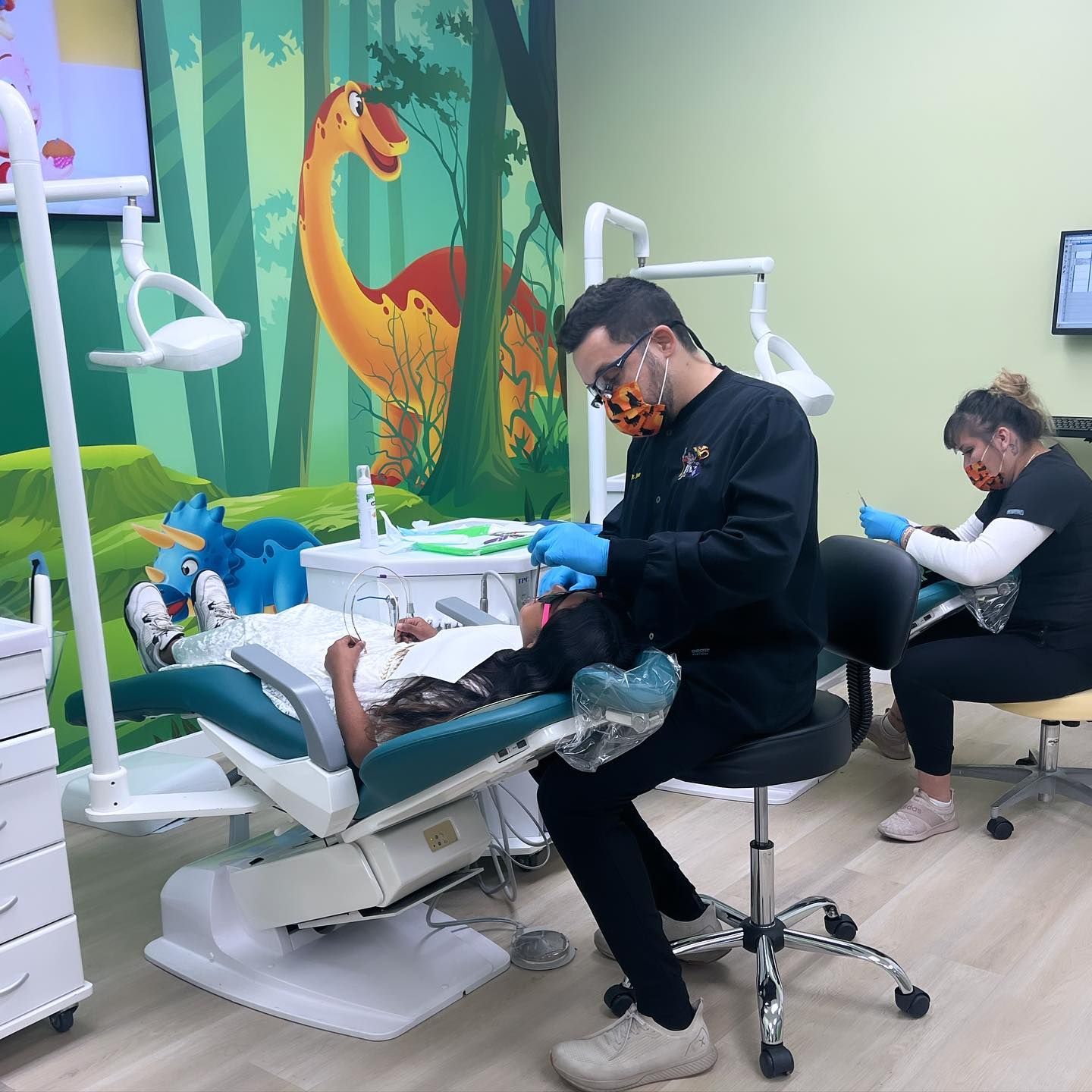
This page is the order of operations: the free, low-stakes things first, then what happens in the room, then general anesthesia. Kids Dental Castle & Orthodontics is thirteen minutes from downtown San Dimas. Dr. Nima Javan is a general and children’s dentist who has focused his practice entirely on children, teens, and patients with special healthcare needs. Four board-certified dental anesthesiologists are on staff, and most children who come to us for “sedation” never need it.
Where the Fear Actually Comes From
Age. A two-year-old who cries during an exam isn’t anxious. He’s two — that’s what a two-year-old does when a stranger tips him backward and shines a light in his face. Much of it resolves between three and five, as language catches up.
A bad first round. A rushed filling, a pinch nobody warned him about, an adult who said “almost done” four separate times. Kids generalize fast and remember accurately — the most common cause we see, and the most fixable, because it responds to the truth.
Sensory sensitivity, needles, gagging. The light, the suction noise, the vibration through the jawbone, or a gag reflex that fires on a mirror at the back molars. This child isn’t frightened so much as flooded, and encouragement doesn’t override a reflex — see special needs dentistry.
And one more, said plainly. Kids read adults before they read rooms. If dentistry is genuinely hard for you, your child likely picked that up from your voice before you finished dialing. That isn’t something you did wrong, and it has a scheduling answer: say so when you book, and another adult brings him, or you wait in the lobby.
What to Do at Home Before the Appointment
Retire five words. Shot. Needle. Drill. Pull. Hurt. None get used in our treatment rooms, so a child carrying them learned them at home. Retire the reassurance too: “it won’t hurt” plants the idea in a kid who hadn’t considered it, and “nothing to be scared of” tells a four-year-old there is. “We’re going to the tooth doctor to count your teeth” is enough.
Aim for his best hour. Not after school, not at 4 p.m. when the wheels come off anyway, not during what used to be the nap. First appointment of the morning is the one to ask for.
Don’t prepare for a week. Telling a five-year-old on Monday about a Friday appointment gives him four days to build it up. The night before is enough; older kids who like to plan are the exception.
Bring his things — headphones and a downloaded show, the stuffed animal, the blanket.
Promise a reward, unconditionally. Small, immediate, certain. “We’re getting a milkshake after” beats a toy next weekend, and it has to hold regardless of how the appointment goes — a reward he can lose by crying is one more thing to be afraid of.
Ask for the Visit Where Nothing Happens
Call and ask for a meet-the-office appointment: your child gets no treatment of any kind. He rides the chair up and down, looks at himself in the little mirror, picks a toothbrush, and you leave — fifteen minutes, most of it him deciding whether to get in it. No charge, no obligation. If he grips the doorframe the whole time, that still counts: the building isn’t unknown anymore.
Tell-Show-Do, and What Happens When Your Child Says No
Tell. Everything gets named in words he already owns, before it comes near him. The little vacuum. The tooth mirror. The spinny toothbrush with gritty toothpaste.
Show. He holds it, and the suction goes on his hand so he hears it somewhere harmless.
Do. Same object, same word, now in the mouth, counted out loud so he knows the end exists and is getting closer. Surprises break trust; sensations don’t.
A stop signal. Left hand up and everything stops — instrument out of the mouth, not after this one tooth. It only works if it’s honored the first time, at the least convenient moment. A child who learns it genuinely works uses it twice, then stops needing to test it.
Some appointments still end early. We don’t finish by force, and nobody here holds a child down to complete a filling. We do what matters most in the time he gives us, then rebook in six weeks instead of six months.
When Talking Isn’t Going to Be Enough
Behavior guidance has a ceiling, and pretending otherwise is how a person ends up forty and avoiding the dentist. It runs out when the child is under three or four, because cooperation then is developmental, not motivational. It runs out when the treatment is large — six teeth, crowns, a nerve treatment — since even a patient four-year-old has about twenty usable minutes. It runs out against a physical limit: a reflex, a movement disorder, an airway that makes lying flat hard. And it runs out against pain, because an infected tooth numbs poorly.
So the choice isn’t sedation versus no sedation. It’s sedation, or failed appointments while the teeth get worse.
Nitrous Oxide
Nitrous is a gas breathed through a soft nosepiece with a scent your child picks; for some kids the nosepiece itself is the obstacle, so he holds it and puts it on himself. He stays awake throughout — answers questions, hears you, can tell us to stop. Kids describe it as tingly hands, or the noises moving farther away. At the end he breathes plain oxygen for a few minutes and it clears; he goes back to school that afternoon. No fasting, nothing lingering.
It suits the nervous but negotiable child: one or two fillings, a sealant appointment, a cleaning that went badly elsewhere. It won’t make an uncooperative child cooperative, and it doesn’t replace anesthetic — the numbing still happens, to a calmer child. See nitrous oxide for children.
IV Sedation and General Anesthesia — Deciding, Not Shopping
The question isn’t whether your child is bad enough for this. It’s how much work there is, and whether he can get through it awake.
IV sedation puts him deeply relaxed and largely unaware, breathing on his own, with an anesthesiologist beside him the whole time; he wakes in the chair and remembers very little. General anesthesia is fully asleep with the airway managed, for extensive treatment or a child who cannot cooperate.
Both happen here, in our office, given by four board-certified dental anesthesiologists on our staff: Dr. Charles Lee, Dr. Albert Kang, Dr. Ji Yoon Choi, and Dr. Andrew Elmasri. Not one anesthesiologist who visits a Friday a month, and not a surgical center across town. Dr. Javan does the dentistry; the anesthesiologist’s only job that hour is your child’s breathing and vital signs. Four on staff is why a sedation date is weeks out rather than months. They also speak several languages between them — Dr. Lee, Mandarin and Cantonese; Dr. Kang and Dr. Choi, Korean; and Dr. Vy Le, another anesthesiologist on our staff, Vietnamese — so if English isn’t the language you’d want to discuss anesthesia in, say so when you call. Fasting instructions come in writing, and he goes home the same day. See sedation and IV sedation and general anesthesia.
Six Appointments, or One
Eight cavities and two crowns, done awake, means one side of the mouth numbed at a time: four to six appointments over three or four months, four to six mornings off work, four to six negotiations in the parking lot. Asleep, it’s one morning, and the next visit is a checkup. Parents who resist general anesthesia are comparing it to an easy appointment; the honest comparison is six hard ones.
Cost, Medi-Cal, and What San Dimas Families Pay
• No insurance: exam and X-rays are free; a $100 new-patient special covers the visit after that.
• Medi-Cal Dental: accepted and billed directly. If your card says IEHP, that’s your child’s medical plan — the dental benefit runs through Medi-Cal Dental either way, and we bill it for you. Bring whichever cards you have. Under 21 it covers cleanings twice a year, X-rays, fluoride varnish, sealants, fillings, crowns, and emergencies. Sedation and general anesthesia are often covered when medically necessary; we confirm before scheduling, not after.
• PPO: in-network with most plans, verified before you come in. No HMO.
• Everything else: a written price before treatment starts, CareCredit, 5% off for cash in full.
Full pricing is on our Chino Hills page and applies here. Routine pediatric dental care and the team have their own pages.
Para las Familias de San Dimas
Alrededor del 37% de las personas en San Dimas hablan en casa un idioma que no es inglés. Se atiende en español desde la primera llamada hasta el final del tratamiento.
Si su hijo lloró, o si otra oficina les dijo que regresaran cuando fuera mayor, empiece por la cita sin tratamiento: entra, se sube a la silla, toca los instrumentos y se va, sin costo. Antes de la cita evite en casa las palabras “inyección”, “dolor” y “taladro”, y no diga “no te va a doler” — esa frase le mete al niño una idea que no tenía.
Cuando eso no alcanza, le explicamos en español el óxido nitroso, la sedación intravenosa y la anestesia general, que permite terminar todo en una sola mañana con cuatro anestesiólogos dentales certificados que trabajan en esta misma oficina. Aceptamos Medi-Cal Dental. Si su tarjeta dice IEHP, ese es el plan médico; el beneficio dental se maneja por Medi-Cal Dental de todas formas, y nosotros lo facturamos. Sin seguro, el examen y las radiografías son gratis. Llame al 909-741-7052.
Getting Here From San Dimas
Kids Dental Castle & Orthodontics — 1532 San Bernardino Ave #A1, Pomona, CA 91767 — 909-741-7052 — Monday–Friday 9–6 · Saturday 8–2
Five miles, roughly thirteen minutes without traffic: the 57 south to the 10 east, then north into Pomona. San Dimas Avenue and Bonita Avenue both reach the 57 in a couple of minutes. From Via Verde or anywhere off the 210, Foothill Boulevard east is usually faster than a freeway at all; from the Arrow Highway side, Arrow east through La Verne skips the interchange. If you’ve driven the kids to Raging Waters or Puddingstone at Bonelli Park, you’ve driven farther than this.
Somebody picks up the phone from 6 a.m. until 9 p.m., every day of the week, and a same-day emergency slot is kept open Monday through Saturday. Bonita Unified’s bell schedule is why Saturday and first-of-the-morning slots go first — if your child is at Lone Hill Middle School or San Dimas High School, ask early. A board-certified orthodontist works here too, so braces later need no referral; pricing is on our San Dimas orthodontics and Invisalign page. We also see kids from La Verne, Glendora, and Covina.
Frequently Asked Questions
An office told us to bring him back when he's older. Will you say that too?
No. Age is one reason a child can't cooperate, but it's a reason to change the approach, not to send you away for two years while the cavity grows. We'll tell you what your child can realistically get through now and what the alternatives are.
Is it normal for a toddler to be afraid of the dentist?
Yes. Fear of strangers and new places peaks between about 2 and 4, so crying at a first visit says more about age than about the dentist. Short, predictable visits that end on a good note are how that fear fades.
Does the meet-the-office visit cost anything?
No. You can book it on its own, with no treatment scheduled and no obligation to book anything after it.
What happens if cavities in baby teeth aren't treated?
They keep growing and can reach the nerve, causing pain, infection and swelling, and an abscessed baby tooth can damage the permanent tooth forming underneath. Baby molars stay in until about age 10 to 12, so they need treatment, not waiting out.
We have IEHP. Do you take it?
Yes. IEHP is your child's medical plan; the dental benefit is administered by Medi-Cal Dental, which we accept and bill directly. Bring both cards if you have them — you don't need to work out which one covers what.
¿Hablan español?
Sí, desde la primera llamada hasta el final del tratamiento. Podemos explicarle en español la sedación, la anestesia general y lo que cubre Medi-Cal antes de programar cualquier cita.
What if my child won't open their mouth at the dentist?
It's common, and forcing it doesn't work. We start with a no-treatment visit so your child can sit in the chair and see the tools. Many children open up by the second or third visit. When treatment can't wait, the next step is nitrous oxide or sedation with our anesthesiologists, not restraint.
What should I say to my child before a dental visit?
Say what will happen, in plain words: "She's going to count your teeth and take a picture." Avoid "it won't hurt" and "be brave"; both suggest something bad might happen. Keep your own tone matter-of-fact, because children read your tone more than your words.
What's the difference between laughing gas and sedation?
Laughing gas (nitrous oxide) relaxes your child while they stay awake and responsive, and it wears off in minutes. IV sedation and general anesthesia go deeper: children sleep through treatment and usually don't remember it. Those are given and monitored here by board-certified dental anesthesiologists. The right level depends on your child's anxiety and how much treatment is needed.
How much does sedation dentistry cost for kids?
Nitrous oxide is a small add-on fee and is often partly covered by PPO plans. IV sedation and general anesthesia are quoted in writing at the consultation, and Medi-Cal Dental covers them when medical-necessity criteria are met; we submit the authorization before scheduling.