Does My Child Need Braces Yet? A Guide for Ontario, CA Parents
Most orthodontic pages for Ontario are written for the parent who’s already decided. This one is for the parent a step earlier — the one whose dentist at a checkup said "you might want an orthodontist to look at this," or who’s looking at a 7-year-old’s crooked front teeth and wondering whether that’s a problem or just a phase.
Short version: around age 7 is the right time for a first look, most kids at that visit don’t need anything yet, and for the minority who do, early treatment is a specific decision with a specific reason — not a default. Every evaluation here is done by Dr. Lyndon Tran, a board-certified orthodontist, in the same building as our pediatric dentists. The consultation is free. Se habla español.
Why Age 7, and What Actually Happens at That Visit
The American Association of Orthodontists recommends a first orthodontic evaluation by age 7. That's not because 7-year-olds get braces. It's because at 7 there's a mix of baby and permanent teeth, the first permanent molars are in, and an X-ray shows how the jaws are growing and where the adult teeth are headed — early enough to catch a crossbite, a severe crowding pattern, or a jaw-growth problem while it's still easy to influence.
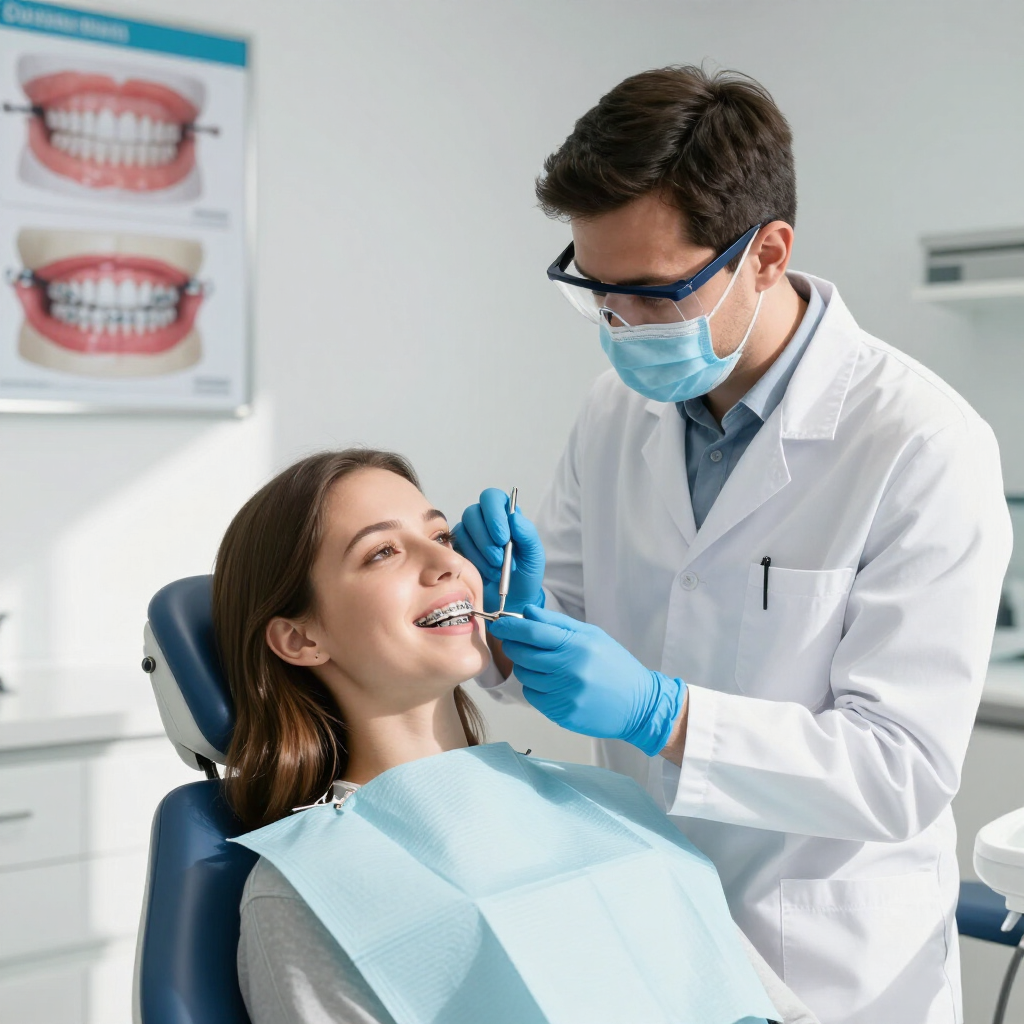
At the visit, Dr. Tran looks at the bite, the alignment, and the panoramic X-ray, and gives one of three answers:
• "Nothing yet." The most common answer at 7. Your child goes on a free recall list and is re-checked every 6–12 months.
• "Let's plan for later." Something will likely need treatment once the permanent teeth are in — usually around 11 to 14 — but starting now wouldn't help. You leave knowing roughly when and roughly what.
• "This one benefits from early treatment." A specific problem that's easier to fix now than later. You'll hear exactly what it is and why.
Nobody is asked to start anything that day.
Phase One: When Early Treatment Is Worth It, and When It Isn't
Worth it for a crossbite (upper teeth biting inside the lower), a severely narrow upper jaw, crowding so significant that permanent teeth have nowhere to come in, a large overjet that puts front teeth at risk of injury, or thumb-sucking effects that are still reversible. In these cases Phase One — typically 12 to 18 months of limited braces, an expander, or Invisalign First — changes the outcome, and sometimes avoids extractions or a longer second phase later.
Not worth it for mild crowding, a slightly crooked front tooth, or spacing that will close on its own as the permanent teeth arrive. Treating those early usually means two rounds of treatment instead of one. Some offices recommend Phase One for most kids; we don't, and we'll tell you which category your child is in.
Phase One pricing: about $3,000, at $300 down and about $150/month for 18 months, 0% interest. Invisalign First (the aligner version for kids with baby teeth, roughly ages 6–10): about $3,500, at $500 down and about $167/month for 18 months.
Invisalign First vs. Braces for a 7-to-10-Year-Old
If early treatment is recommended, there are usually two ways to do it. Braces (partial, on the front teeth and molars) or an expander are the traditional route and work regardless of how cooperative the child is. Invisalign First does many of the same things with removable aligners — no brackets, easier brushing — but only if the aligners stay in 20–22 hours a day. A 7-year-old who'll wear them is a good candidate; a 7-year-old who'll leave them in a lunchbox is a braces candidate. Dr. Tran will ask you honestly which one you have.
Later: Comprehensive Treatment for Chaffey-District Teens
Once most permanent teeth are in — usually 11 to 14 — full treatment happens if it's needed. Comprehensive braces run about $3,500 ($300 down, about $133/month for 24 months). Comprehensive Invisalign runs about $4,000 ($500 down, about $146/month for 24 months). Complex cases up to about $4,500. Both typically take around two years. Which one fits comes down to what needs to move and whether aligners will actually get worn.
For Chaffey, Ontario, and Colony High students, adjustment visits are 20–30 minutes every 6–8 weeks for braces, or check-ins every 8–12 weeks for Invisalign, and we schedule after-school slots.
Medi-Cal, IEHP, and PPO in Ontario
Medi-Cal Dental covers braces for children when the case is medically necessary under the state's criteria — a significant bite problem, not a cosmetic one. It does not cover Invisalign. Our office takes the records and submits the authorization; you get a plain answer. If the case doesn't qualify, the self-pay pricing above applies.
IEHP is accepted, and orthodontic coverage follows the same medical-necessity process.
PPO plans usually cover a portion of orthodontic treatment, often as a lifetime maximum. We verify your specific benefit before your visit. Many Ontario-Montclair and Chaffey district employee plans include an orthodontic benefit — bring your card and we'll check.
Paying for It
Zero-interest in-house financing (the figures above), CareCredit, and a 5% discount for paying in full in cash — the discount stacks with CareCredit if you pay the full amount through it up front. Two children in treatment means two plans; there's no rule that they have to overlap.
Meet Dr. Lyndon Tran
Dr. Tran is board-certified by the American Board of Orthodontics. He attended dental school at New York University, where he was recognized as a top student in the orthodontic honors program, and completed his orthodontic residency at NYU. Every evaluation and every treatment plan here is his — the free age-7 look included.
Orthodontist or General Dentist?
Several Ontario dental offices offer braces or Invisalign through a general dentist. A general dentist is trained in all of dentistry; an orthodontist completes two to three additional years of residency in tooth movement and jaw growth specifically, and a board-certified one has passed the American Board of Orthodontics' examination on top of that. For a simple adult case the difference may be small. For a growing child — where the question is whether and when to intervene in jaw development — it's the whole question.
Ontario Ranch and Families New to the Area
If you've moved into Ontario Ranch, New Haven, or one of the newer neighborhoods in the south end, you may not have a dentist or orthodontist yet. Our pediatric dentistry team and Dr. Tran are in the same building in Pomona, a straight run up the 60 or the 10 — so a first cleaning and a first orthodontic look can happen the same afternoon. Same-day appointments are often available.
Where We Are
Kids Dental Castle & Orthodontics
1532 San Bernardino Ave #A1
Pomona, CA 91767
909-741-7052
From Ontario: the 10 west or the 60 west to Pomona, or Holt Boulevard straight through. We also see orthodontic patients from Montclair, Chino, Upland, and Rancho Cucamonga. Se habla español.
My 7-year-old's front teeth are crooked. Is that a problem?
Usually not by itself — crowding often improves as the jaw grows and baby teeth are lost. The free evaluation tells you whether it's the normal kind or the kind that needs a plan.
Is Phase One orthodontics necessary?
Only for specific problems: crossbites, severe crowding, jaw growth issues, or habits affecting the bite. For most 7-year-olds, the right answer is to monitor and wait. Dr. Tran recommends early treatment only when waiting would make the problem harder or more expensive to fix.
Is Invisalign First the same as regular Invisalign?
No. It's designed for kids who still have baby teeth, roughly ages 6–10, and addresses early problems. Comprehensive Invisalign is for once most permanent teeth are in.
Does Medi-Cal cover braces in Ontario?
For medically necessary cases, yes. It doesn't cover Invisalign. We handle the authorization.
Does IEHP cover braces?
We accept IEHP. Orthodontic coverage follows the same medical-necessity process as Medi-Cal Dental, and we submit the paperwork.
How much do braces cost per month?
About $133/month for 24 months after $300 down, at 0% interest, for comprehensive braces. Phase One is about $150/month for 18 months after $300 down.
Is the consultation really free, even for a 7-year-old who probably doesn't need anything?
Yes. Exam, scan, and X-rays, no charge. Most 7-year-olds leave with "nothing yet," and that's a good outcome.
Does my child need a palate expander?
Only if the upper jaw is too narrow, usually seen as a crossbite or severe crowding. An expander works best between about 7 and 12, while the upper jaw is still growing. Appliances like expanders can add $500 to $1,500 depending on the case, and the written estimate includes it.
Can braces fix an underbite?
Mild to moderate underbites usually can, especially in children, where early treatment can guide jaw growth. Severe skeletal underbites that become clear in the late teens sometimes need jaw surgery alongside braces. An evaluation around age 7 leaves the most options open.
What does an orthodontist check at age 7?
How the upper and lower jaws are growing, whether permanent teeth are coming in with enough room, how the bite lines up front to back and side to side, and habits like thumb sucking. Most children only need a yearly check; a few benefit from early treatment.
Do you speak Spanish?
Sí. Se habla español en nuestra oficina.
How can I tell if my child needs braces?
Signs include crowded or overlapping teeth, front teeth that stick out, upper teeth that sit behind the lower ones, a jaw that shifts when biting, baby teeth lost very early or very late, and mouth breathing. None of these means treatment is certain; each is a reason to have an orthodontist look.